
Artículo de investigación
Non-linear spectral matching for asbestos detection in urban hyperspectral imagery using dynamic time warping
Emparejamiento espectral no lineal para la detección de asbesto en imágenes hiperespectrales urbanas mediante alineamiento temporal dinámico
Recibido: · Aceptado: · Publicado:
Cómo citar: Chanchí-Golondrino, G. E., Ospina Alarcón, M. A., & Saba, M. (2026). Non-linear spectral matching for asbestos detection in urban hyperspectral imagery using dynamic time warping. Amazonia Investiga, 15(88), 29–43. https://doi.org/10.34069/AI/2026.88.02.2
Abstract
Hyperspectral remote sensing has gained importance in applications such as biomedicine, agriculture, and environmental monitoring, where spectral signatures enable material detection using computational methods. This article presents the implementation and evaluation of the Dynamic Time Warping (DTW) method for detecting asbestos in hyperspectral images. The method is compared to the widely used correlation technique. The research follows the CRISP-DM methodology, adapted into four phases: business understanding, data preparation, modeling and evaluation, and deployment. Results show that the DTW method is effective for detecting asbestos in hyperspectral images, though it is less sensitive and less computationally efficient than the correlation method. The study suggests that the DTW method is suitable for identifying materials with non-linear spectral variations and can be applied to detect other materials beyond asbestos. Given the public health relevance of asbestos detection, this method can contribute to more precise identification of asbestos-cement roofs in urban areas. The use of open-source libraries such as Spectral, NumPy, SciPy, and FastDTW for the implementation highlights the accessibility of this approach for academic and industrial applications. This work aims to serve as a reference for future research on the detection of materials using DTW in hyperspectral imaging.
Keywords: Dynamic temporal alignment; asbestos; correlation; hyperspectral imaging; remote sensing.
Resumen
El sensado remoto hiperespectral ha ganado relevancia en biomedicina, agricultura y monitoreo ambiental, donde las firmas espectrales permiten detectar materiales mediante métodos computacionales. Este artículo presenta la implementación y evaluación del método de alineamiento temporal dinámico (DTW) para la detección de asbesto en imágenes hiperespectrales, comparándolo con la técnica de correlación ampliamente utilizada. La investigación sigue la metodología CRISP-DM, adaptada en cuatro fases: entendimiento del negocio, preparación de datos, modelado y evaluación, y despliegue. Los resultados muestran que el método DTW es efectivo para la detección de asbesto en imágenes hiperespectrales, aunque es menos sensible y eficiente computacionalmente que el método de correlación. El estudio sugiere que el método DTW es adecuado para identificar materiales con variaciones espectrales no lineales y puede aplicarse para detectar otros materiales además del asbesto. Dada la relevancia de la detección de asbesto para la salud pública, este método puede contribuir a una identificación más precisa de cubiertas de asbesto-cemento en zonas urbanas. El uso de bibliotecas de código abierto como Spectral, NumPy, SciPy y FastDTW para la implementación destaca la accesibilidad de este enfoque para aplicaciones académicas e industriales. Este trabajo pretende servir de referencia para futuras investigaciones sobre la detección de materiales utilizando DTW en imágenes hiperespectrales.
Palabras clave: Alineamiento temporal dinámico; asbesto; correlación; imágenes hiperespectrales; sensado remoto.
Introduction
Hyperspectral remote sensing, also known as imaging spectroscopy, involves capturing images across numerous narrow spectral bands to obtain detailed spectral information, enabling the identification and analysis of materials based on their spectral behavior (Eismann, 2012; Gu et al., 2021; Shukla & Kot, 2016; Zhang & Zhong, 2010). Hyperspectral images can be represented as three-dimensional data cubes containing two spatial dimensions associated with the X and Y coordinates of the image, and one spectral dimension containing information from different wavelengths (Burger & Gowen, 2011; Gao & Smith, 2015; Gowen et al., 2011; Park, 2016). This information has enabled applications in environmental monitoring, agriculture, geology, biomedicine, and material identification (Gao & Smith, 2015; Lu et al., 2020; Park, 2016).
Asbestos comprises a group of naturally occurring silicate minerals that have been extensively used in industrial and construction applications due to their thermal resistance and mechanical properties. One of its most common applications is asbestos-cement (AC) roofing, which remains present in many urban environments. However, deterioration, weathering, or disturbance of asbestos-containing materials may release hazardous fibers into the environment, creating significant public-health concerns (Butnor & Roggli, 2024; Cilia et al., 2015; Darnton, 2023; Emmett, 2021; Saba et al., 2023; Thives et al., 2022). Consequently, identifying the spatial distribution of asbestos-containing roofing is an important preliminary step for environmental risk assessment, planning of removal interventions, and the management of asbestos-containing construction and demolition waste. Remote sensing techniques have therefore become relevant for identifying and mapping AC roofing over large urban areas (Cilia et al., 2015).
Despite the potential of hyperspectral imaging for material identification, several challenges remain. Spectral signatures of the same material may exhibit variability due to acquisition conditions, surface properties, illumination, and other environmental factors. Furthermore, different materials may present partially overlapping spectral characteristics, making their discrimination difficult (Ahmad et al., 2022; Datta et al., 2022; Li et al., 2019). The high dimensionality of hyperspectral images also increases the computational cost of pixel-level analysis (Mohan & Porwal, 2015; Plaza et al., 2009; Zhang & Du, 2012). These characteristics motivate the evaluation of similarity measures capable of comparing spectral signatures while tolerating local variations in their shape or alignment.
Traditional similarity measures such as correlation compare spectral profiles through direct relationships between corresponding spectral values and have been successfully applied to material detection in hyperspectral imagery. However, such approaches do not explicitly perform local non-linear alignment between spectral profiles. Dynamic Time Warping (DTW), in contrast, allows local stretching and compression of sequences and can therefore accommodate non-linear variations between spectral signatures. Although DTW has been extensively investigated for sequence alignment and pattern recognition (Ge & Chen, 2020; Jiang & Chen, 2023; Keogh, 2002; Zhang et al., 2021), its use as a spectral matching strategy for asbestos detection in urban hyperspectral imagery remains comparatively underexplored. In particular, there is limited evidence regarding its ability to discriminate asbestos from other urban materials and the computational cost associated with pixel-level hyperspectral analysis.
Accordingly, this study evaluates Dynamic Time Warping as a non-linear spectral matching method for asbestos detection in urban hyperspectral imagery and compares its discrimination capability and computational efficiency with a conventional correlation-based approach. The evaluation uses a hyperspectral image of the Manga neighborhood in Cartagena, Colombia, containing 725 × 850 pixels and 380 reflectance bands.
The main contributions of this study are: (i) the adaptation and implementation of DTW for comparing asbestos spectral signatures in hyperspectral imagery; (ii) an experimental comparison between DTW and correlation using asbestos and non-asbestos samples; (iii) an assessment of their computational efficiency; and (iv) the application of both methods to an urban hyperspectral image section to analyze their spatial detection behavior. The method was implemented using open-source Python libraries such as Spectral, NumPy, SciPy, Pandas, Matplotlib, and FastDTW.
These contributions are particularly relevant to environmental and civil engineering, as the identification of asbestos-containing materials has important implications for public health and construction and demolition waste management. Furthermore, evaluating DTW as an alternative spectral matching approach may support its future application to other hazardous materials and environmental monitoring problems.
The remainder of this article is organized as follows. Section 2 presents the literature review on hyperspectral material detection, asbestos identification, and spectral matching approaches. Section 3 describes the methodology and implementation of DTW and correlation. Section 4 presents the experimental results and discussion, while Section 5 summarizes the main conclusions and future research directions.
Literature review
Hyperspectral imaging has been extensively employed for material identification across multiple application domains. In environmental monitoring, hyperspectral data have supported natural-resource management and the identification of terrain, vegetation, and water characteristics (Manolakis et al., 2014; Willett et al., 2014; Yan et al., 2021). In agriculture, hyperspectral imagery has been used for crop classification, quality assessment, disease monitoring, and water resource management (Khan et al., 2018; Mahesh et al., 2015). Other applications include military target detection, explosive identification, and hyperspectral microscopy for the characterization of heterogeneous materials at micro- and nanoscale levels (El-Sharkawy & Elbasuney, 2019; Roth et al., 2015).
Previous studies have demonstrated the feasibility of hyperspectral imaging for the identification of asbestos-containing materials. The mapping of asbestos-cement roofs and their weathering status has been investigated using aerial hyperspectral imagery. (Cilia et al., 2015). Hyperspectral imaging has also been applied to the identification and classification of asbestos fibers. (Bonifazi et al., 2015) as well as to the detection of asbestos-containing materials considering specimen preparation and handling (Serranti et al., 2019). Advanced technologies have also been investigated for the detection and classification of asbestos and other contaminants in construction and demolition waste (Serranti & Bonifazi, 2020). Furthermore, hyperspectral imaging combined with hierarchical PLS-DA has been applied to asbestos recognition in construction and demolition waste, demonstrating the relevance of spectral analysis not only for urban mapping but also for material separation and waste-management applications (Bonifazi et al., 2019) Remote-sensing applications for asbestos have been reviewed, highlighting the relevance of spectral signatures for recognizing asbestos-containing materials (Torres Gil et al., 2023). In related work, distance and correlation metrics have been evaluated for vegetation identification in hyperspectral imagery, demonstrating the applicability of spectral similarity measures for material identification (Chanchí Golondrino et al., 2023). These studies confirm the usefulness of spectral signatures and similarity metrics for hyperspectral material detection. However, conventional point-to-point similarity measures do not explicitly address local non-linear alignment between spectral profiles, which motivates exploring alternative matching strategies.
Dynamic Time Warping is a sequence-alignment method designed to identify an optimal correspondence between two sequences through local stretching or compression. Unlike direct point-to-point comparison, DTW can align similar patterns even when corresponding features occur at slightly different positions. This flexibility has motivated its application in pattern recognition and sequence analysis (Ge & Chen, 2020; Jiang & Chen, 2023; Keogh, 2002; Zhang et al., 2021).
In the context of the present study, wavelength-indexed reflectance signatures are treated as ordered numerical sequences. This representation enables the evaluation of DTW for spectral matching, allowing local variations in the position or shape of spectral features to be accommodated during comparison.
The literature therefore shows that hyperspectral imaging is well established for material identification and that several approaches have been proposed for asbestos recognition. Nevertheless, the studies reviewed above primarily rely on spectral characteristics, statistical similarity measures, or supervised classification methods. Comparatively less attention has been given to non-linear sequence-alignment methods such as DTW for matching asbestos spectral signatures in urban hyperspectral imagery. Furthermore, the potential benefit of its flexible alignment must be considered together with its computational cost and its ability to discriminate asbestos from spectrally similar urban materials. These aspects define the specific problem investigated in this study.
Methodology
For the development of this research, the CRISP-DM methodology for data science project development was considered, from which an adaptation to four methodological phases was made: F1. Business Understanding, F2. Data Preparation, F3. Modeling and Evaluation, F4. Deployment (see Figure 1). The CRISP-DM methodology provides a standardized, clear, structured, and flexible approach for data science project development, allowing for adaptation to different contexts and iterative review of the various phases of the process (Martinez-Plumed et al., 2021; Saltz, 2021; Schröer et al., 2021; Sharma et al., 2017). In this research, the DTW method was chosen because of its ability to handle variability in the length and alignment of spectral signatures. Since the spectral signatures of materials such as asbestos can show nonlinear variations due to factors such as illumination or environmental conditions, DTW is presented as an effective solution to obtain accurate alignments between reference signatures and those observed in hyperspectral images. Previous studies have shown that DTW outperforms other traditional methods in terms of accuracy and robustness when it comes to identifying materials under uncontrolled conditions(Ge & Chen, 2020; Keogh, 2002).
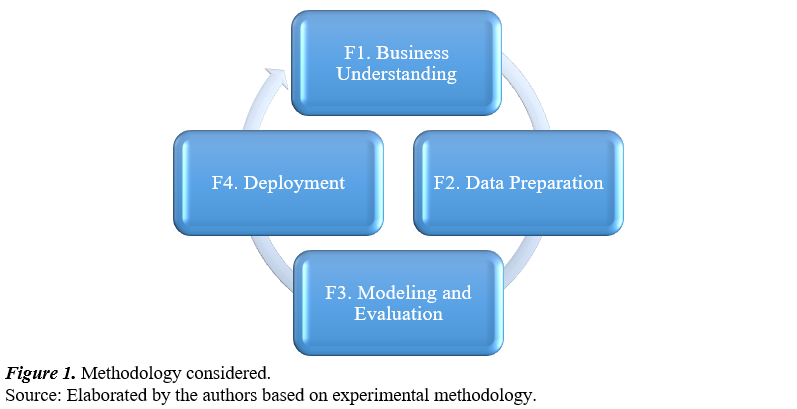
In phase 1 of the methodology, mathematical and computational techniques for determining asbestos pixels in hyperspectral images were identified and characterized, which involves detecting the spectral signature of this material in comparison to other materials. In line with this, the present article characterizes and applies the Dynamic Time Warping (DTW) method to the domain of hyperspectral images, comparing it with the implementation of the correlation method in the context of asbestos detection in hyperspectral images. The Dynamic Time Warping method is an algorithm that can be used to measure the similarity between two temporal sequences that may vary in speed or length. Mathematically, DTW seeks to find an optimal alignment between the points of two time series, minimizing the differences between them over time, allowing for local stretching or compression.
The DTW method has been successfully used in hyperspectral image analysis for applications related to data mining and complex pattern detection. Its ability to perform temporal alignment between spectral signatures allows the method to adapt to variations inherent in images captured in dynamic environments. In this study, DTW was compared with the correlation method, which has been widely employed in the identification of materials in hyperspectral images, although it has limitations when spectral signatures vary in length or shape (De Luca et al., 2024; Wan et al., 2025).
On the other hand, in phase 2, a hyperspectral image of the Manga neighborhood in the city of Cartagena was chosen as the dataset for the evaluation and deployment of the DTW method. The image consists of a total of 725x850x380, meaning a total of 616,250 pixels with 380 hyperspectral bands. From this image, the reflectance values were normalized to the range of 0 to 1, and a total of 150 sample pixels were selected through visual inspection (75 asbestos pixels and 75 non-asbestos pixels). The 75 asbestos pixels were used to obtain the average pixel or characteristic spectral signature of asbestos.
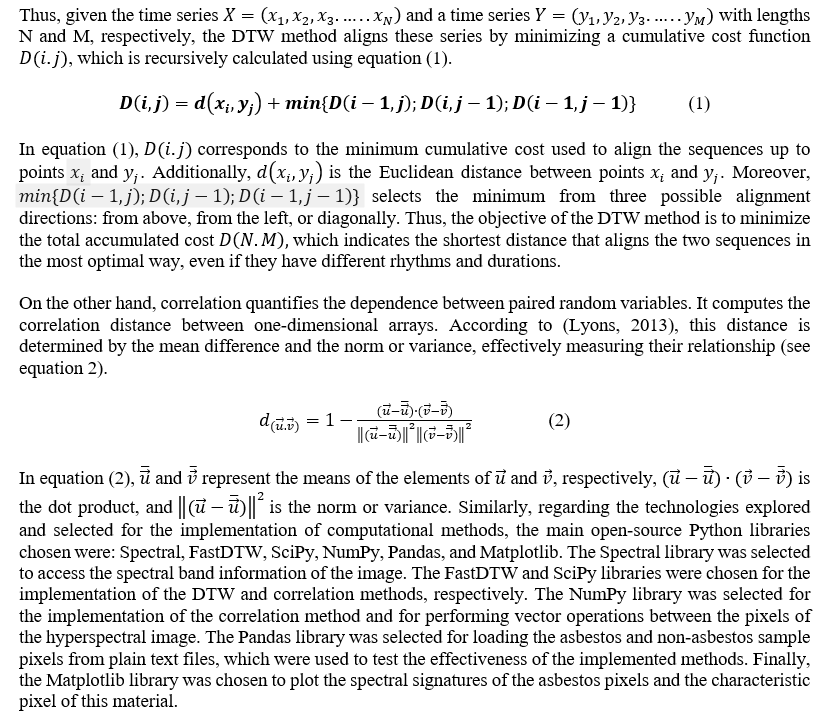
In phase 3 of the methodology, the average pixel or characteristic spectral signature determined in phase 2 was used to compare it with the 75 asbestos pixels and 75 non-asbestos pixels using the two selected methods (correlation and DTW) to assess the effectiveness of these methods in identifying asbestos pixels. Thus, in this phase, a correlation and similarity percentage with the asbestos spectral signature is obtained, respectively, from the metrics defined in equations (1) and (2), allowing the calculation of a minimum threshold at which both methods begin to detect asbestos pixels. It is important to note that the two methods considered and compared in this research were implemented using the libraries selected in phase 1. Similarly, in this phase, the efficiency of the compared methods is evaluated through the execution of the methods with different run counts (from 10 to 50).
For the DTW implementation, the FastDTW library was selected, which is a more efficient version of the classical algorithm and allows faster evaluation on large datasets. FastDTW achieves this by approximating the time series alignment using a recursive approach of lower computational complexity, making it an ideal tool for the analysis of high-resolution hyperspectral images (Herrmann & Webb, 2023). In the implementation used in this study, the FastDTW function was executed with a constraint window radius of 1 (radius = 1), corresponding to the default parameter value of the library. This parameter was maintained throughout all DTW experiments to ensure consistency and computational reproducibility.
Finally, in phase 4 of the methodology, the deployment of the two implemented methods was carried out on different image sizes. For both methods, the identification and counting of the determined asbestos pixels were performed, as well as the percentage of asbestos corresponding to the evaluated section of the image. This involved scanning the selected image section pixel by pixel, from left to right and top to bottom, comparing each pixel with the characteristic pixel using the two considered methods.
Results
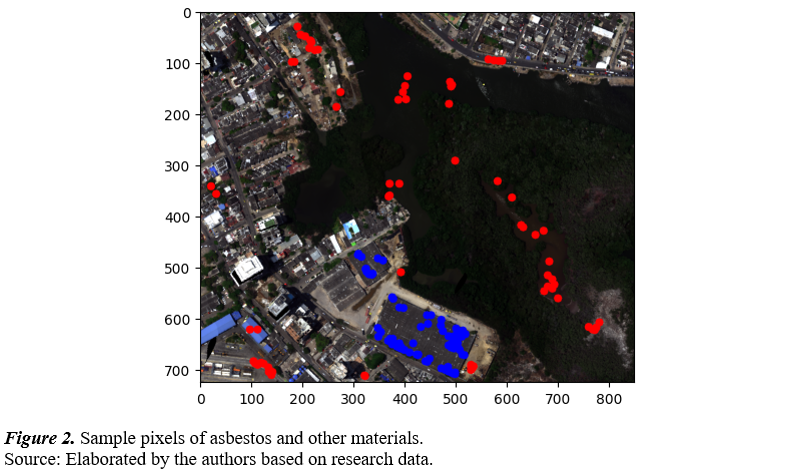
As previously mentioned, this study utilized a hyperspectral image dataset measuring 725x850 pixels with 380 spectral bands. A selection of 150 sample pixels was made, comprising 75 asbestos and 75 from various other materials (vegetation, freshwater, roads, metal roofs, among others). The objective was to evaluate the efficacy of the DTW method for asbestos pixel identification. Thus, Figure 2 presents an RGB representation of the hyperspectral image, where asbestos pixels are highlighted in blue and pixels of other materials in red. The blue pixels correspond to the roofs of buildings in the city where the material was known to be asbestos.
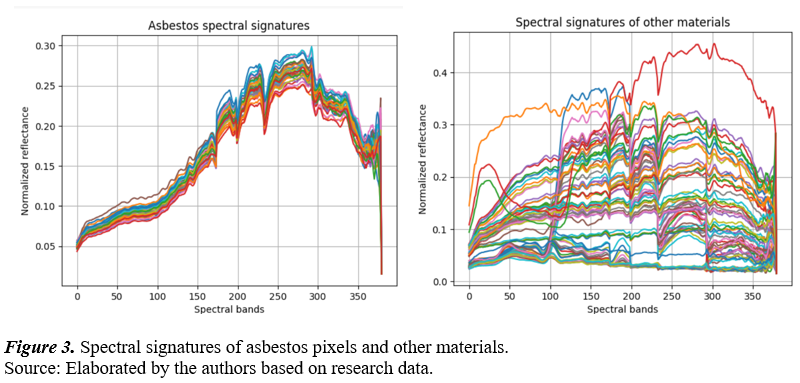
From the 75 selected asbestos and non-asbestos pixels, the spectral signature of each was obtained, which corresponds to the reflectance values for the 380 bands that make up the hyperspectral image. Thus, Figure 3 presents the spectral signatures of the asbestos pixels and the other materials selected for the sample.
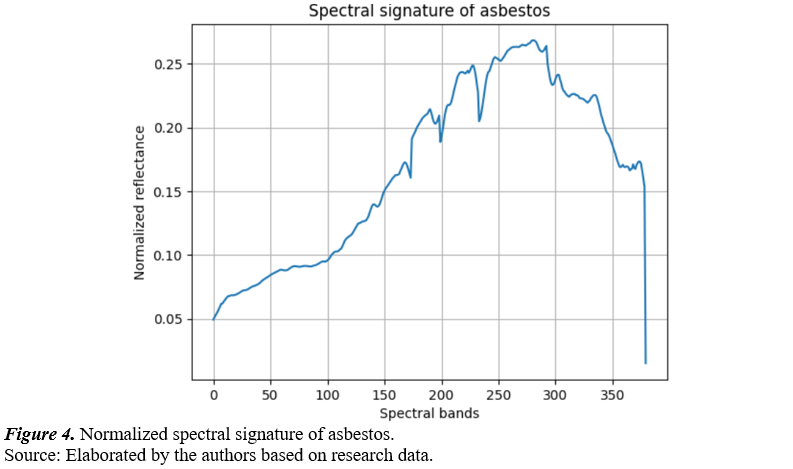
Using the 75 asbestos pixels obtained from the sample as a reference, the average pixel or normalized characteristic spectral signature of asbestos was calculated. This signature is used by the methods to determine whether the spectral signature of a given pixel is similar to the reference signature. This signature was determined by leveraging the advantages provided by the NumPy library and is presented in Figure 4.
The DTW and correlation methods were implemented in such a way that they respectively provide a correlation percentage, and a similarity percentage based on distance. First, these methods were evaluated against the 75 asbestos pixels and the 75 non-asbestos pixels in order to determine if the methods are sensitive enough to detect asbestos pixels in a hyperspectral image. Thus, Figure 5 presents the application of the DTW method in relation to the 75 asbestos and non-asbestos pixels.
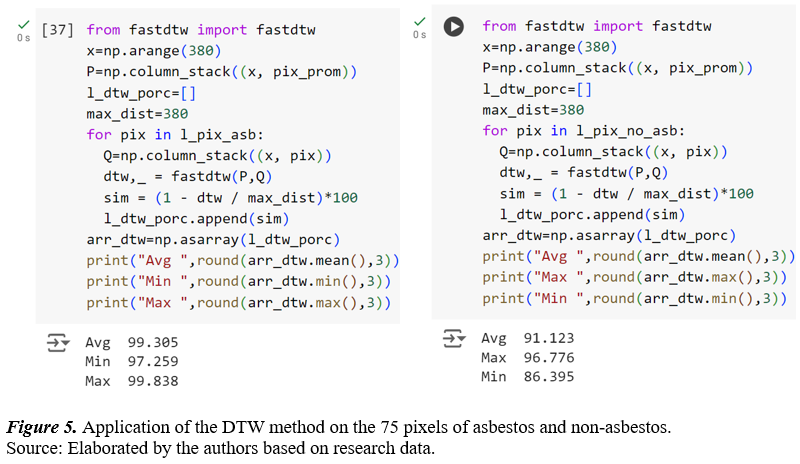
It is possible to observe from the evaluation presented in Figure 5 that, for asbestos pixels, an average similarity percentage of 99.305% is obtained using the DTW method, with a minimum percentage of 97.259%. On the other hand, for non-asbestos pixels, an average similarity percentage of 91.123% is obtained using the DTW method, with a maximum percentage of 96.776%. This indicates that the DTW method does not present any confusion in asbestos detection, as the minimum percentage obtained for asbestos (97.259%) does not overlap with the maximum percentage obtained for non-asbestos pixels (96.776%), with a difference of 0.48%. Furthermore, when comparing the DTW method with the correlation method for the asbestos and non-asbestos sample pixels, the result is shown in the graph presented in Figure 6.
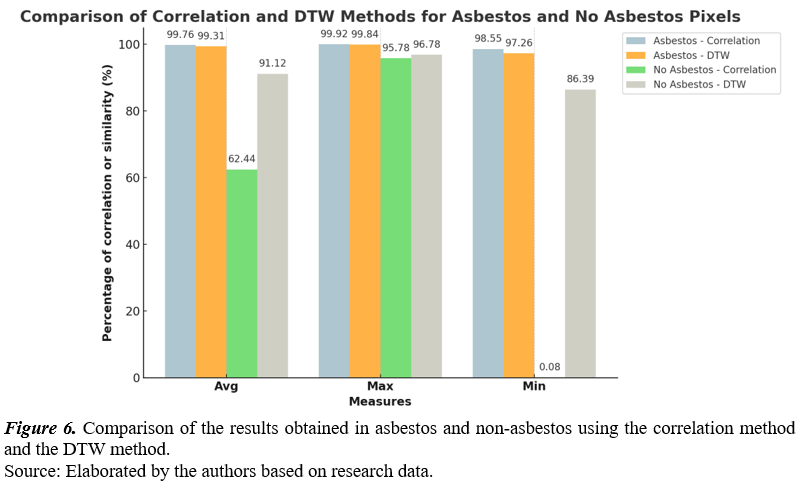
As shown in Figure 6, the correlation method presents higher correlation percentages between the characteristic pixel and the asbestos and non-asbestos pixels. It can be observed that, for the asbestos pixels, an average correlation percentage of 99.761% was obtained, with a minimum correlation percentage of 98.551%. Similarly, for the non-asbestos pixels, the correlation method achieved an average correlation percentage of 62.443% and a maximum correlation percentage of 95.778%. Thus, it can be seen that, as expected, the correlation method does not show any overlap between the minimum correlation percentage for asbestos pixels (98.551%) and the maximum correlation percentage for non-asbestos pixels (95.778%), with a difference of 2.773%. Therefore, although there is no overlap in either of the two methods considered, the correlation method demonstrates better sensitivity in distinguishing asbestos pixels from those of other materials.
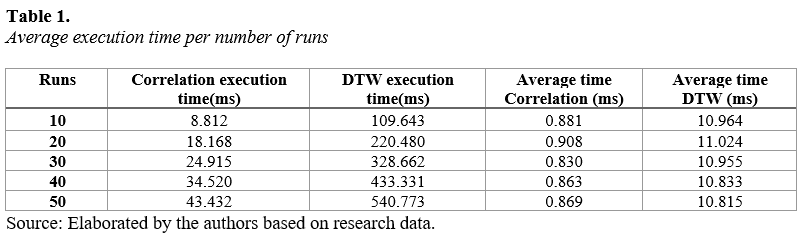
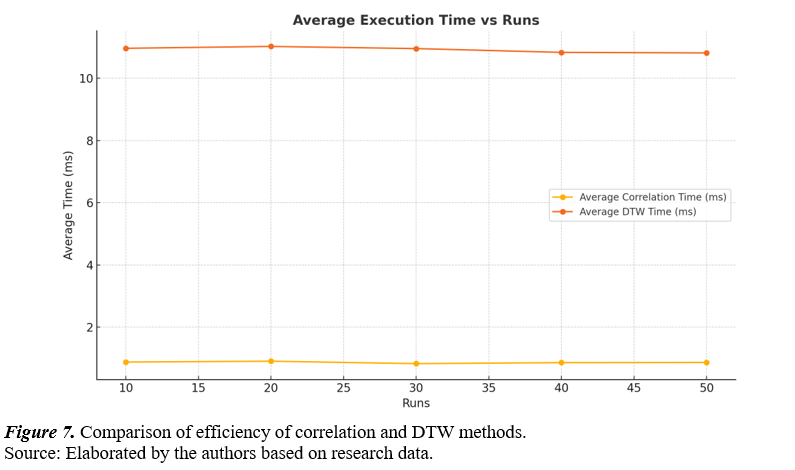
On the other hand, in order to evaluate the efficiency of the DTW method compared to the correlation method, both methods were applied to a 100x100x380 portion of the reference image. A total of 10, 20, 30, 40, and 50 repetitions were performed for each method using Python's timeit library, which allows a method to be executed a specified number of times to obtain the average execution time. Additionally, this library provides the ability to measure execution time with high precision, ignoring any system overhead, and offers options to adjust the number of repetitions or configure the testing environment, ensuring reliable and accurate results. The execution times and average execution times for the repetitions performed by each method are presented in Table 1. It is worth noting that these results were obtained in the academic environment of Google Colab with 12.7 GB of RAM.
It can be seen from Table 1 that the average execution times for the correlation method range between 0.881 milliseconds and 0.908 milliseconds, with an average time per repetition of 0.870 milliseconds. Similarly, for the DTW method, the average execution times range between 10.815 milliseconds and 11.024 milliseconds, with an average time per repetition of 10.918 milliseconds. Thus, it can be observed that the correlation method is 12.54 times faster than the DTW method. This can be seen more clearly in Figure 7, where the average execution times for the repetitions performed with both methods are compared.
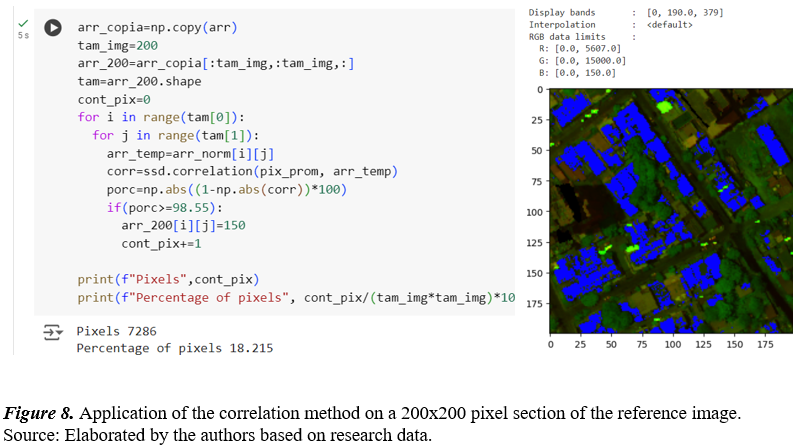
Finally, in order to evaluate the proposed methods beyond the 75 sample pixels, these pixels were evaluated on a 200x200x380 section of the reference image. For each method, the number of identified asbestos pixels and the percentage of those pixels within the considered image section were calculated. Thus, Figure 8 shows the application of the correlation method on the image section and the results obtained regarding the number of determined pixels and the detected asbestos zones. In this case, the correlation method identified a total of 7,786 pixels, corresponding to 18.215% of the image.
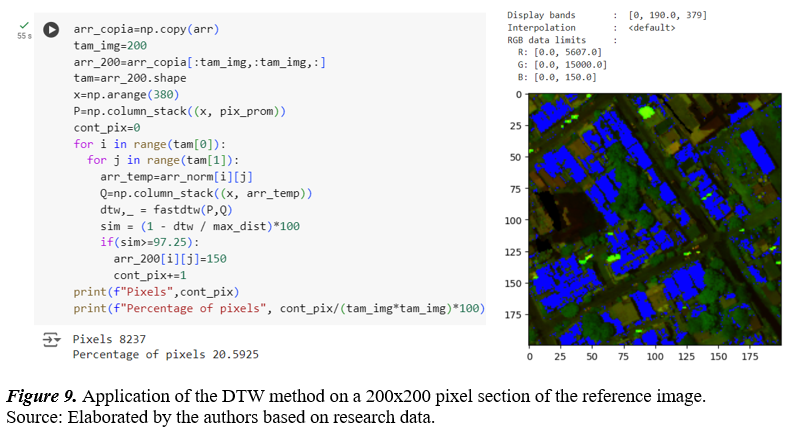
On the other hand, Figure 9 shows the application of the DTW method on the image section and the results obtained regarding the number of determined pixels and the detected asbestos zones. In this case, the DTW method identified a total of 8,237 pixels, corresponding to 20.5925% of the image.
Discussion
As a discussion point, it is important to mention that this article contributes by implementing and evaluating the DTW method for detecting asbestos pixels in hyperspectral images, which builds on the proposal in (Torres Gil et al., 2023), where a visual method is suggested for detecting asbestos based on its spectral signature, using the maxima and minima of the spectral signature in specific spectral ranges. In this regard, the proposed DTW-based method is suitable for detecting the shape of the spectral signature, as it has been adapted to work with reflectance data across spectral bands, although it is traditionally used for temporal sequences. This adaptation allows DTW to non-linearly align reflectance curves, adjusting to local variations between bands, which is crucial for identifying similarities in the overall shape of the spectral curve, regardless of differences in specific bands or their amplitude.
On the other hand, the method proposed in this article, having proven to be effective in identifying asbestos pixels, represents a valid alternative for identifying asbestos and other materials in the domain of spectral images, where one of the most widely used methods is correlation (Chanchí Golondrino et al., 2023). Thus, although this research found that the correlation method is less prone to errors in asbestos detection than the DTW method, the particularities of the spectral signatures of different materials may make one method more effective than the other in different scenarios. Therefore, at a research level, the DTW method is a valuable contribution to consider for material detection in hyperspectral images.
Regarding the classification maps, the apparent false-positive detections may be associated with the spectral variability of urban surfaces. Variations in illumination conditions and building shadows can modify the reflectance signatures of roof materials, potentially increasing the similarity between non-asbestos surfaces and the asbestos reference signature. Likewise, the weathering state of asbestos-cement roofs may alter their spectral response, since aged, stained, or deteriorated surfaces can differ from the characteristic signature used as reference. These factors may affect the two evaluated methods differently. Correlation measures the overall similarity between spectral profiles and may be affected by changes in the spectral response caused by illumination, shadows, and surface conditions. DTW can accommodate local variations in spectral signatures through non-linear alignment; however, this flexibility may also align spectral features of non-asbestos materials with the asbestos reference signature, potentially increasing false-positive detections. This behavior is consistent with the experimental results, where the separation margin between asbestos and non-asbestos samples was 0.48% for DTW and 2.773% for correlation. Nevertheless, because exhaustive pixel-level ground-truth information was not available for the complete analyzed image, these detections should be interpreted as potential false positives rather than conclusively misclassified pixels.
Conclusions
Given the existing challenge in the field of hyperspectral imaging to identify and evaluate mathematical and computational methods different from conventional ones, which allow for the effective detection of various types of materials, this article proposed the implementation and application of the DTW method for asbestos detection in hyperspectral images. This method was considered relevant because, given the challenge in this context of detecting the shapes of spectral signatures, it allows for the flexible alignment of reflectance curves across different spectral bands, even when non-linear variations or shifts occur. This makes it a suitable tool for identifying characteristic asbestos patterns by adapting to differences in intensity or wavelength, ensuring accurate detection of the material's spectral signatures.
When evaluating the DTW method with the 75 asbestos pixels and the 75 non-asbestos pixels, it was found that this method allows the differentiation of the asbestos spectral signature with a percentage difference of 0.48%. Thus, it can be stated that although this method enables the differentiation of asbestos pixels, its sensitivity to distinguish asbestos pixels from those of other materials is lower than that of the correlation method, in which the percentage difference between the correlations obtained for asbestos and non-asbestos pixels is 2.773%. Despite this, the results have identified a promising method to be evaluated and used in the detection of different materials, considering that this method may be more effective with other types of materials.
The method implemented and evaluated in this article was compared in terms of efficiency with the correlation method, showing that after a different number of repetitions on a 100x100x380 hyperspectral image, the correlation method, in the academic environment of Google Colab, had an average execution time of 0.870 milliseconds, while the DTW method had an average execution time of 10.918 milliseconds. This indicates that although both methods proved to be effective, the correlation method is 12.54 times more efficient than the DTW method. In this regard, it could be considered for future work to apply the DTW method to a reduced set of representative bands identified using information gain methods.
Given the widespread use of proprietary tools for hyperspectral image analysis, such as ENVI, this study demonstrated the relevance and application of a set of open-source libraries and technologies for the analysis and processing of these images using mathematical and computational methods such as correlation and DTW. In this way, the Spectral library proved to be suitable for reading and accessing the reflectance bands of hyperspectral images. Similarly, the SciPy, FastDTW, and NumPy libraries were shown to be relevant for the implementation of the correlation method and for performing operations between the 380-band arrays representing different pixels of the image. Finally, the Pandas and Matplotlib libraries were suitable, respectively, for reading the 75 reference points and generating the corresponding graphs of the spectral signatures.
Finally, the use of open-source Python libraries in the proposed approach contributes to democratizing access to hyperspectral analysis and environmental monitoring tools by reducing dependence on proprietary software and facilitating the reproducibility and adaptation of the methodology. This accessibility may support researchers, public institutions, and environmental agencies with limited technological resources in developing tools for asbestos identification, contributing to risk assessment and the safe management of asbestos-containing waste in urban environments.
As future work derived from this research, the use of the DTW method is intended to be extrapolated for the detection of different materials in the context of hyperspectral images, so that its performance can be evaluated in comparison to correlation for the detection of specific spectral signatures.
Declarations
Author contributions: Gabriel Elías Chanchí-Golondrino: Methodology, Formal Analysis, Investigation, Writing – Original Draft. Manuel Alejandro Ospina-Alarcón: Conceptualization, Methodology, Writing – Original Draft. Manuel Saba: Conceptualization, Methodology, Writing – Review & Editing, Supervision. All authors have read and approved the final version of the manuscript.
Funding: This research was funded by an internal research project of the University of Cartagena entitled: “ENVIRONMENTAL CHANGE DYNAMICS IN URBAN ENVIRONMENTS OF THE COLOMBIAN CARIBBEAN: AUTOMATED DETECTION OF ASBESTOS-CEMENT USING DEEP LEARNING APPLIED TO MULTISPECTRAL IMAGERY”
Conflict of interest: The authors declare that they have no conflicts of interest that could have influenced the research, authorship, or publication of this manuscript.
Use of artificial intelligence: The authors declare that artificial intelligence (AI) tools were used solely to assist in improving the graphical style and visual presentation of the figures through modifications to the code used to generate them.